Monday, February 06, 2006

'Certified Censor' increasingly popular career choice in US


Is censorship becoming the norm in the United States?

Three high-profile censors materialized in quick succession during the past, oh, week or so: first Google, then NASA, and now the National Football League.

The NFL's victims were the Rolling Stones, or rather: Rock&Roll itself. On-duty censors blanked out two phrases from the Stones' Super Bowl halftime performance, in two hitherto uncontroversial songs: 'Start Me Up', and 'Rough Justice'.

They were able to do this because of the 5-second tape delay ABC imposed on the broadcast, thanks to Janet Jackson's 'halftime wardrobe malfunction' two years ago. ABC probably learned the '5-second-delay-and-finger-on-the-button-trick' from the Chinese authorities, who have been doing exactly that for years to foreign broadcasters like BBC World Service and CNN International.

Rock&Roll will never be the same.

Web 1.0 to co-exist with Web 2.0


Good catch for Goodmail Systems, an email certification provider; a bad day for the Internet. Today two of the largest email providers in the world, AOL and Yahoo, announced they will start using a system for preferential treatment of email. AOL also announced its intended provider, which is to be Goodmail. Yahoo apparently wasn't ready yet to announce a choice.

This announcement comes at a time when telcos like AT&T and BellSouth are mulling a two-tier Internet, transmitting their own download and streaming services faster than those of others.

AOL and Yahoo's move to two-tier email will undoubtedly strengthen the telcos' case. Are the days of net neutrality over? A bit early to tell. AOL and Yahoo position their move as an anti-spam and anti-phishing service, directed at large-scale senders of mission-critical email. Think order confirmations and invoices. Likewise, the telcos' musings so far have only taken the form of fishing expeditions.

Will the past ten years go down in history as the Golden Decade, never to be seen again? To be continued.

Sunday, February 05, 2006

OK. Who ordered the 'Google #1 Hypocrite' mugs?


Microsoft, Yahoo and Google censor Chinese search words and results (see Suggested motto: don't be hypocrites, Brin to blogosphere: "Forget about Don't Be Evil. We're now going for Do Be Practical and White-shirted students activist morphs into white-shirted middle-aged tourist). In addition, Yahoo helps China to violate basic human rights by tracking down journalists who publish things Beijing wants to keep under wraps. And Cisco built the infrastructure that's now known as the Great Firewall of China.

You'd think that these four companies, who have recently found themselves in a position where they had to defend these controversial decisions and their reputations in public, would grab an invitation from the US Congress to talk about these thorny issues with both hands.

But no. One after the other called with excuses that they had other priorities. One emailed. (Which is interesting in itself, but let's not digress.)

Especially Google, given its motto, has an obligation to support the public discussion on how to operate under dicatorships, how to respect human rights, and how to weigh the interests of the public involved. In refusing to participate, Google shows its true colours as a company that interpretes "Don't Be Evil" as "Maximize Shareholder Value"

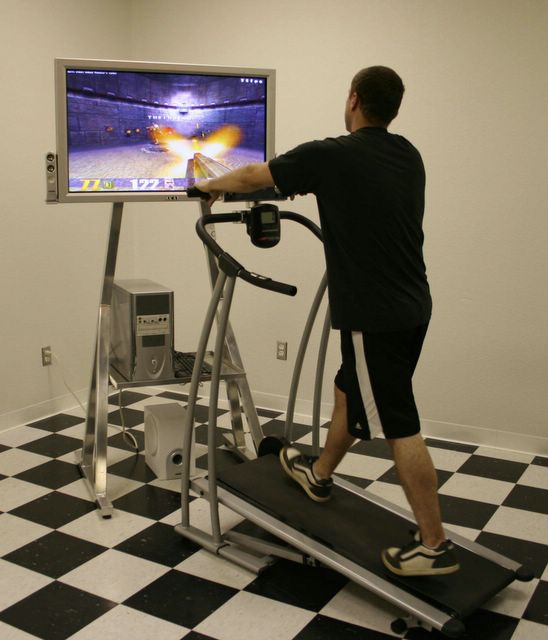
"Are you still into video games? You seem to look... different"


Here's one in the category "Why didn't I think of this before?" The FP (as in 'First Person') GameRunner not only helps you work out while playing first-person shooter games, it forces you to.

The treadmill functions as a controller, replacing the 'walk' command with the treadmill function itself. So if you don't want to die, you'll have to keep running. Literally. Steering and shooting controls on the handlebars help you survive in cyberspace.

Meanwhile, in the real world, you start to look increasingly like your avatar, with legs like tree trunks and a sixpack for a stomach. Plugs into your PC's USB port and works with any first person shooter.

But wait, there's more! It also folds under your bed. Seriously.

Boeing to speed up inflight information systems innovation to once every 20 years?


Volkswagen, Google and Nvidia are teaming up, it seems, to build a Google Earth-based car navigation system.

The idea is to use satellite image-derived pictures on the carnav screen so you can relate what's on the screen more easily to your actual surroundings.

Cool idea, wrong application. Such a system requires a lot more accuracy than Google Earth can offer now or in the near future. But it's good news for inter-city nomads: it's about time that the inflight navigation systems which first started to appear about 20 years ago were revamped. The little screens showing you the plane's progress seem somehow to have fallen between the cracks of progress.

The most obvious coalitions would be - let me think - Microsoft and Boeing ("Seattle Satnav Systems") and Google plus Airbus ("Euro Earth Entertainment").

Come on guys, who gets there first?

Friday, February 03, 2006

First mention of 'hypertext' unfortunately only on paper


Today the word "hypertext" reached the respectable age of 41.

The concept itself was invented by Vannevar Bush, in his famous July 1945 essay "As we may think" in The Atlantic Monthly. Vannevar Bush's essay formed the inspiration for the two actual inventors of hypertext, Ted Nelson and Douglas Engelbart.

Prof. Nelson was the one who coined the word, in a Vassar College Miscellany News article dated February 3rd, 1965. Three years later Doug Engelbart went on to design the oNLine System (NLS) at Stanford Research Institute, the first in history to implement practical use of hyperlinks and the main subject of the Mother of All Demos.

Those were days that were to have a profound influence on all our lives.

Thursday, February 02, 2006

IRS computer system hit by 'Bill Gates Bug'


It looks like Bill Gates has found a major source of inspiration in this year's Annual WEF meeting.

Having left Davos and being freed from the self-imposed obligation to make off-the-wall predictions, the Microsoft Chairman has subsequently launched into ridiculing web censorship, a subtle way of rubbing salt in rival Google's wounds.

And to top it all, there are some really funny remarks on the US Tax Authorities' ineptness to handle 11-digit tax applications. That's obvious material for follow-up jokes, but first prize goes to John Paczowsky in today's GMSV: 'Microsoft Chairman Bill Gates [apparently] wonders why the IRS is still taking his "640K ought to be enough for anyone" comment seriously'.
ROTFL

Wednesday, February 01, 2006

Great invention. Now, about that acronym...


"who's going to invent the lightweight mini battery?" asked this blog 3 weeks ago. After seeing the CES gadgetfest, featuring flexible screens, low-power processors and instant startup capablity, this was the missing link in the personal gadget evolution.

Well, here it is. It's rechargable, too. This paper-thin energy cell has been developed by NEC in Japan. They've worked six years on it, and the energy source is a type of plastic in gel form currently known as 'organic radical polymers.' Yep, ORPs.

This tells us two things: 1. it's solid state so it can be bolted directly on processor boards and 2. the inventor is not a marketing type. It also needs more inventing: energy density, charging time, and reliability are still issues that need some work. On the plus side, the materials are completely environmental friendly.

Expect it to reappear in a few years' time in the form of a paper-thin computer, and under a completely different name.

After the limelight, the truth sinks in


After having basked in the luxury of this blog being quoted in several European quality newspapers, most notably London's Financial Times (paid access) and Madrid's El Pais, a sobering note about old vs. new media.

Careful analysis leads me to say that being quoted in these major newspapers, with a combined circulation of more than 1 million, has brought this blog around 5 additional hits (add plus or minus 5 for the error margin). That's not counting emails, phone calls and other messages received from friends and acquaintances who were surprised to see my name appear in their favourite rag.

I think we can draw two firm conclusions here. One, rumours about old media's death are greatly exaggerated. Blogs being all the hype, there's still no blog that can measure up against reach and awareness of classic newspaper titles.

And two, there's apparently very little overlap between the two types of media. New is new and old is old, and ne'er the twain shall meet.

Tuesday, January 31, 2006

"Our helpdesk system detected some urgency in your request, Sir"


Nice technology scoop from my alma mater, Groningen University, or rather: from one of its technology spinoffs, Sound Intelligence.

SI specializes in intelligent automatic sound recognition. Its sound sensors can be programmed to distinguish between a smooth-running engine and one with worn-out parts, or to recognize the sound of breaking glass or other burglary-related noises.

The technique is so robust that it can do all this even when the progammed sound is 'drowned out' by background or other noise. The company's current hot item is the 'Agression Detector', a security camera that can detect whether human sounds are produced by aggressive or non-aggressive individuals, and swivel and focus on aggressors in a crowd. An experiment in Groningen's city centre has just been succesfully concluded.

For a Direct Marketing mind, no more cues are needed. I can picture a host of applications here, from prioritizing support requests in a helpdesk's voicemail box to intelligent voice response systems. (No, that is not necessarily a contradiction in terms.)

Venture capital firms are kindly request to leave a comment with this post. You will be contacted as soon as possible.

Finally: competition for the world's poorest customers


It's a good thing when the likes of Nicholas Negroponte and Bill Gates start to devote part of their considerable resources to fighting poverty by bringing things like affordable laptops and proper healthcare to the Third World.

But novel as these admirable initiatives may sound, they still boil down to traditional charity. Negroponte doesn't want his laptop to cost less than $100 to keep the sales price down: he wants to keep the costs down of giving them away. Ditto the Bill&Melissa Gates Foundation with its future cures for infectious diseases.

A small niggling voice inside me that charity, even this new kind of charity, brings short-term relief rather than long-term development. You don't help people by giving them things, you help them by developing the instincts to get these things for themselves. Microcredit, for instance, its that bill perfectly.

So it's promising and refreshing to see how a large and wealthy corporation like Microsoft is now actually starting to compete for the nearly three billion potential consumers. After Negroponte's choice for Linux as the designated $100 laptop OS, Microsoft has gone out of its way to promote a competing initiative centered around the cellular phone, turning it into a computer with the help of a cheap adapter, a keyboard and a TV.

The world's largest corporations genuinely competing to become low-cost suppliers to the poorest prospects in the world: let's hope this is the beginning of a worldwide trend.

Mobile payments: Japan leads the way


More mobile marketing news from Japan, where it all seems to be happening: the official introduction of Mobile Suica, a service that enables Japanese consumers to pay with a wave of their handphones things ranging from Japan Rail train tickets to fast food and electronics goods.

The six handset models that were promised to work with the service as announced last month now turn out to have become a full dozen, from providers NTT DoCoMo and KDDI. Unfortunately, three more Vodafone handsets that also support the technology are not (yet?) supported.

This will not stand in the way of a substantial increase in mobile payments in Japan, though. The number of Suica compatible handsets sold by DoCoMo alone has passed the 10 million mark.

Zip my colours, please


The impact of Quick Response codes for response generation in marketing cannot be exaggerated. In future they will become the supreme drivers for consumer response, from information requests to buying decisions.

QR codes, the squiggly blach-and-white squares, can already be seen on posters, theatre tickets, name cards and even on boarding passes.

But even before QR's widespread acceptation a sucessor has `already been announced: the Colorzip code. Colorzips are a Korean development, started six years ago at Yonsei University. They are now the de facto code reading standard in Korea, and are being introduced in Japan as we speak.

The greatest advantage of colorzips is their design flexibility: instead of being confined to squiggles or squares, colorzips can be morphed into any form that contains colour codes, and still be easily readable. The same goes for printing them on textured or flexible surfaces such as T-shirts or shopping bags, or even showing them on TV screens, not to mention mobile phones and other gadgets. In addition they can contain a lot more information than the QR codes' usual 300 characters.

Will colorzips become the new standards? To be continued.

(Thanks Douwe and Molblog.)

Programmable electronic computer now 62 years old


On 31 January 1944 the first programmable electronic computer in the world, the Colossus Mark I, was installed in the British cryptographers' headquarters in Bletchley Park.

It had been constructed over the previous ten months by Tommy Flowers, at the British Post Office Research Station at Dollis Hill in North London, for the purpose of breaking German cypher codes.

Colossus predated its more famous cousin ENIAC by two years. The machine operated on 1,500 vacuum tubes (ENIAC would use around 18,000) and was programmed by paper tape which was optically read. Because of the fragility of the vacuum tubes, the machines, once turned on, were never powered down until the World War's end.

The machine helped the Allied Forces win the war, and in honour of that a replica was built in 2003, which can still be admired at the Bletchley Park Museum.

In Search of Evilness


You've got to hand it to them: Google did it again.

After single-handedly innovating the worlds of search, advertising, webmail and just about all other things internet, Google has now handed business consultancy it's biggest innovation since Tom Peters wrote 'In Search of Excellence".

McKinsey&Company have recalled their regional heads for a worldwide meeting, as a new standard slide has to be added to all the consultancy's future reports: the Evilness Chart.

I can't help but wondering if the chart was also used to determine Google's refusal to hand over search data to the US federal Government.

Monday, January 30, 2006

It's about time


Did you ever realize? Someone asks you the time, you look at your wrist and answer. But the answer you give is never precisely what you see. It's always "five o'clock", or "a bit past five". Unless you're German or otherwise anally focused, of course.

Design company Talus have finally come up with a watch design that tells you the time exactly like you tell others. This is a really cool idea.

Of course, given the current comeback of mechanical timepieces, a version powered by a mechanical high-end movement would be even cooler. IWC, Ulysse Nardin, where are you?

UPDATE: For our more anal readers, not to worry: by clicking the crown the watch toggles between 'about time' and exact time, showing hours, minutes and seconds (Thanks Norman for pointing out the omission.)

Sunday, January 29, 2006

White-shirted student activist morphs into white-shirted middle-aged tourist


Google's much-criticized announcement to start a censored search engine in China has given rise to a new national sports: doing parallel searches on both Google.com and Google.cn and comparing the results.

And of course the discrepancies are huge, at least if you choose some nicely controversial keywords.

Here's what you get when you do an image search for 'tiananmen' on Google.com, and here are the corresponding Google.cn results. Americans get 22,400 images, with the first results pages dominated by the famous tank column being stopped by a white-shirted activist. Chinese only get 414, barely 2%, of these, mostly tourists' holiday snapshots on the famous square.

The picture with the white-shirted tourist above is result #29 on .com, #2 on .cn. Wonder if it's the same guy.

"Next time you break into our database, could you please leave the Californians alone?"


On Thursday the Federal Trade Commission (FTC) and consumer targeting information company ChoicePoint reached a landmark $15 million settlement for endangering the privacy of more than 160,000 consumers in February 2005.

The settlement includes a $10 million fine, the largest so far for a privacy breach.

A further $5 million is set aside by ChoicePoint to compensate consumers who fell victim to identity theft as a result of the breach. Since the FTC said 800 consumers ended up being victimized, this settlement sets an interesting benchmark of around $60,000 per record for privacy breach compensation where marketing data are involved.

ChoicePoint's database was compromised by criminals who set up fraudulous accounts that enabled them to access 162,000 records. Interestingly the whole affair only came to light because ChoicePoint had to comply with California's 2003 disclosure law, requiring the company to disclose security breaches to state residents whose information has been affected.

Saturday, January 28, 2006

2005 Not too dumb a year for DM


The 101 Dumbest Moments in Business for 2005 are out, and as always they make quite funny reading. For Direct Marketing aficionados, here's a small selection of DM related bloopers and their rankings.

#8: The hazards of voice response
Anheuser runs the "Mr Discount-Airline-Pilot-Guy" ad and AirTran Marketing Director Tad Hutcheson feels insulted. Tad calls the brewer, gets put on hold and is forced to listen endlessly to a loop containing the offensive ad. AirTran threatens to de-list Budweiser.

#51: The hazards of Deceased Do-Not-Contact lists
The Direct Marketing Association decides to charge the deceased $1 for making the list. The bereaved object.

#64: The hazards of renting 3rd party lists
Standard procedure should always be screening against a hoax name list. JPMorgan apparently doesn't know this and manages to send a credit card offer to an Arab American man, addressed to 'Palestinian Bomber.' No comment.

#98: The hazards of database analysis
Mail order company eZiba runs itself into the ground by doing a database analysis and subsequently mailing its catalogue to the least likely responders instead of the most likely ones. Great analysis job, though!

Only 4 out of 101, and not even the highest rankings: 2005 was all in all not a bad year for DM. Then again, ChoicePoint's security breach that endangered the privacy of over 160,000 people, resulting in the identity theft of 800 of them apparently didn't make the 2005 dumb list.

Given that it's only January and we already saw nearly half a million people's records lost or stolen from employees' cars, this year's start isn't exactly promising. Let's hope for the best.

Friday, January 27, 2006

Data protection? You mean we have to lock our cars?


It's been a bad week for privacy and data protection in the US.

Yesterday Providence Home Services, a Portland, Oregon healthcare provider, confessed that 365,000 patients' records have been stolen from an employee's car on New Year's Eve, four weeks ago. The data included about 250,000 Social Security numbers. Apparently the disks and tapes that held the data were sitting in the car as part of a routine precaution against data centre disasters. The procedure has now been changed.

And the day before Minneapolis-based financial services firm Ameriprise reported the theft of another 226,000 customer records, also late last month. These data too were stolen from an employee's car.

These are serious numbers, from serious companies who should know better. Ameritrust is a recent American Express spinoff. But the most striking part is the apparent carelessness with which the most sensitive types of data - healthcare, finance, and Social Security numbers - are apparently routinely taken off site, in laptops or on media, and left around in cars and God knows where else.

Unbelievable.

Gates + Davos = Predictions


What the bell did to Pavlov's dog, the World Economic Forum apparently does to Bill Gates: trigger an autonomous reaction. Either that, or it's the Swiss mountain air.

Either way, when Bill goes to Davos, you may hold your breath: come rain, come shine, there will be predictions. But although he's easily the most succesful entrepreneur in the world his track record in making predictions is less than stellar.

His forecast of spam's defeat in two years' time being proven false just four days ago apparently did not deter him from predicting victory over software piracy in China and India. In a speech at the WEF Bill Gates claimed to be optimistic about China and India becoming more licence-friendly, comparing the situation in those countries to Taiwan and Korea a few years ago.

Mr Gates is becoming a bit more careful at the future-betting game, though. This time he predicted victory in ten years, rather than two. Watch this space on January 27th, 2016.

George Washington's long tail


Remember Where's George? Fill in the number of your dollar bill, where you got it and where you are now.

With enough participation bills will surface every now and then, and you'll be able to track your bill's circulation in space and time. Cute.

That was five-odd years ago, and Where's George lived happily ever after. But now George's saga is getting a new twist. Scientists at the Max Planck Institute in Goettingen, Germany, are now proposing to use George's database to predict the spread of infectious diseases like bird flu. The researchers have developed a mathematical model that uses human travel to plot the future course of pandemics, but lack a sufficiently robust database of human movements. According to recent analysis George's database of 50 million dollar banknotes seems to be the next best thing.

Interesting development at a time when business models are increasingly judged on the length of their tails.

Thursday, January 26, 2006

Brin to blogosphere: "Forget about Don't Be Evil. We're now going for Do Be Practical"


Add transparency to hypocrisy and what do you get? Sergei Brin in Davos.

Asked about Googles decision to launch a censored search service in China in the margin of the World Economic Forum meeting he's attending, Brin defended it explaining: "I don't like it either but in the end we decided less information is better than no information."

Brin admitted critics of the decision do have a point, but, he said: "France and Germany require censorship for Nazi sites, and the U.S. requires censorship based on the Digital Millennium Copyright Act (DCMA). These various countries also have laws on child pornography."

That's an interesting ethical shortcut. Brin basically says "China thinks human rights are evil, France and Germany think Nazis are evil, the US think child pornography and violating copyrights is evil. What am I to think?"

Nice try, Sergei.

Wednesday, January 25, 2006

Suggested new motto: "Don't Be Hypocrites"


As of today, it's official. Google's "Don't Be Evil" motto has withered in the face of China's opposition against maintaining any type of human rights within the Middle Kingdom's borders.

Today Google announced the Chinese version of their search page, which promises to censor any reference to obscenities like democracy, porn, and human rights. In addition Google have decided not to introduce Blogger and Gmail in China, just to avoid finding itself in the position of having to hand over personal data to the Chinese government.

Microsoft and Yahoo had already succumbed to similar Chinese pressure by censoring search results and even by handing over independent-minded journalists to their jailers respectively, but let's face it - these two companies never plastered the frickin' motto all over their Investor Relations pages.

Google did, and it just turned out to be an empty promise in the face of 'political realities'. Makes you wonder if Google will grant future Chinese requests for search data, or if they'll stand fast like they did against the US government's recent porn fishing expedition.

My advice: don't hold your breath.

Tuesday, January 24, 2006

"I used to give iPods for Valentine. Now I give Valentines to my iPod"


Things are getting out of hand.

A little while ago we predicted tech is the new bling. Bear in mind this is all about using tech to look cool and sexy, people.

It's not, repeat, not about dressing up your iPod for Valentine. So get out there, bling up and find a real person to talk to!

Singapore forecasts 'sell' rating for eBay


Blog shops are conquering Asia.

Not only shopping paradise Singapore but also technology-savvy Japan see the rise of small online shops, created by posting articles, descriptions and prices on the web by using a simple blog interface. All you need is a digital camera, PC and internet connection, and you're in business. Literally.

Does eBay need to start worrying?

Source: Straits Times

Monday, January 23, 2006

Bill and bets: two down, one to go


During his regular appearances at the World Economic Forum in Davos Bill Gates likes to make a prediction or two.

One of these made headlines all over the world: spam would be solved in two years' time. That was on January 23rd, 2004, exactly two years ago. Ah, well.

One year later, on January 29th, Bill was doing his 'Davos thing' again. “I’m short the dollar,” he said in an interview with TV host Charlie Rose. “The ol’ dollar, it’s gonna go down.” The dollar was worth 77 Eurocents at the time. It's 81 today. Can't win'em all, Bill.

Back to Davos 2004, where Bill made a second prediction. This one, a bit less publicized, was about Google. A "pretty good" competitor with a "high level of IQ", Bill said, but "we will catch them."

No two years' time span on this one. And hopefully for Bill, a bit more accurate than the other two.

American marketers taking Year of the Dog extremely serious


It was unavoidable: a mobile phone for pets. PetsMobility from Scottsdale, Arizona, has developed a bone shaped device that sits on your favourite canine's collar.

The phone has a 'Call Owner' button in case it ends up with strangers (or in case your dog's clever enough to use it himself - ya never know) and an auto answer function that can filter out calls from other numbers than your own. So your dog isn't in jeopardy of auto answering telemarketing calls, I guess. It can still receive them, though, as the phone has its own number. So you'll have to register your dog to the Do Not Call Registry as well, it seems.

Still, one wonders why the thing has the shape of a bone. For meeting other dogs, perhaps? A good thing it's waterproof, then.

Sunday, January 22, 2006

22 Years ago today: first sighting of Steve Jobs' Reality Distortion Field

A historic moment in the history of ICT and one of the most famous (some would say infamous) TV commercials of all time was the '1984' Macintosh launch ad.

The commercial cost $1.6 million to produce, and Apple paid another $500,000 for the 45 seconds of airtime. It ran only once, during the third quarter of the January 22nd, 1984 Superbowl, and it marked a seminal moment in personal computing history.

It was also the first public sighting of Steve Jobs' Reality Distortion Field, a phenomenon that was known at Apple since 1981 and still is annually on display at Apple's MacWorld Expo.

"We wanted to do a promotion but we're not really sure we want any response"


SMRT, Singapore's dominant public transport and taxi operator, clearly hasn't figured out how to do SMS promotions.

This ad in SMRT's subway trains tells you how to participate by sending an SMS with your taxi's licence plate number, receipt number, journey start date & time, and your passport or identity card number. Seriously. The ad even gives an example how simple such an SMS would look: SMRT, SHB1234A, 999, 011105, 1033, S77712345A.

Let's just hope SMRT didn't deploy too many extra taxis to cope with promotional demand...

Saturday, January 21, 2006

Reincarnated Liberace sighted in Hong Kong


And here I thought very little had happened in grand piano design for the last century or so. How wrong can one be.

This Schimmel Pegasus Grand Piano was on display in a shop in Hong Kong's Times Square. It's a Colani design, done completely in high-gloss automobile lacquer (complete with American 60s type hood ornament - seriously) and according to Schimmel's website it's available in the standard grand piano colours jet black and mother-of-pearl white.

Trust a Hong Kong firm to order one in Ferrari red, of course.

Thursday, January 19, 2006

I, for one, welcome our new spiritual overlords


When analysts start to predict that Google's stock price may hit $2000 you don't need to be a rocket scientist to figure out that the hype around Google is on its way to become a craze.

But when reputable business magazines like The Economist start comparing Google to a religion, calling The Algorithm its God and St Lawrence of Google its Prophet, you just know you have a craze of mythical proportions on your hand. The Economist even speculates that Larry and Sergei are on a holy mission to change the world with all their billions of dollars.

Pulling billioms of dollars out of the market in order to start a religion might even become a trend. At least that's what the Maharishi Mahesh Yogi must've thought when he started his latest campaign, asking the world for nothing less than 10 trillion dollars. Buy one or more shares for $50,000 each and you'll be part of the Maharishi's global initiative to eliminate poverty.

Guess I'd rather put my money on the Religion of the Omniscient and Omnipotent Algorithm, as The Economist calls it.

Wednesday, January 18, 2006

Thanks, I'd rather live online


You live in a dorm with many others, and there's never a moment of privacy. You have almost no free spending money, and can afford very little luxury. You go to university in a city where real estate prices have gone through the roof, and owning or renting an apartment is a distant opportunity. So you go online.

This is, in short, the explanation for the wild success of Chinese website iPartment. iPartment is an online world where you can find an apartment, find someone to share it with and go and live there happily ever after.

And that's exactly what about half a million Chinese 18-25 year olds have done since the site's launch in July 2005. Couples spend time in their apartment, chatting in relative privacy, decorating it with furniture and luxury goods, or taking care of their pets. Stuff, pets and petfood can be bought at the site for a small fee.

Participants seem to love this cheap, commitment-free life and often spend hours a day on the site. The site turns a handy, though unreported, profit. This is China, after all.

You don't find the combination of low-income, internet-savvy youths in many other places, but I can't help but wonder if we'll see this phenomenon pop up elsewhere.

For Your Eyes Only: James Bond meets Star Trek


You can fill an entire conference these days with wearable electronics and other stuff that makes you look like one of the bad guys in Star Trek.

But this one I couldn't resist posting: video glasses that generate the sensation of a 42" LCD screen right in front of your eyes.

Why is posting this so irresistible? Not sure. Maybe it's the ridiculous idea that some people will shell out more than 500 bucks for a gadget that's outright dangerous to wear. Or maybe it's because the thing makes you look like one of those criminal suspects whose eyes have been covered in a newspaper photograph.

Or else it's the press photo, another splendid proof that Bling is King and the iPod is the ultimate Bling.

Microsoft and Google kick off convergence between internet and mass media


What promises to be the 21st century titan's fight over online media between Microsoft and Google has hardly begun, and already it's spilled over to the airwaves.

Last Thursday Microsoft showed a demo with a new technology enabling viewers of online video to click on objects they see on the screen, taking them immediately to ads for relevant products. The guys in Redmond also announced heavy investments in their newly formed adCenter Incubation Lab, which will concentrate Microsoft's research into advanced advertising technologies.


And an hour ago Google finally gave us an idea about the way they're going to spend all those billions in cash, by announcing the acquisition of radio advertising company dMarc Broadcasting.

dMarc connects advertisers to radio stations through an automated platform. Google wants to integrate this technology into their AdWords programme, which basically does the same for websites. In the near future Google's AdWord clients will be able to buy both online and radio advertising from one single source.

This is not just a skirmish any more. Google will overpay up to $1.2 billion for dMarc, a company that was formed as recent as 2004, in a deal worth $29 million. And this is just the beginning...

Monday, January 16, 2006

Moonrise over flight SQ5902


Not bad for a camera phone, eh?

Traditional marketing in high-tech city


Singapore, Chinatown. Midnight shopping madness in the run-up to Chinese New Year. A nice and refreshing change from glitzy high-rise shopping centres full of gadgets and luxury brands.

It's the middle of the night, but it could just as well be the middle of the day. Keong Saik Road has been turned into a crowded market that offers everything you need to celebrate the beginning of the Year of the Dog.


Lucky bamboo


Orange trees, for prosperity


Would you think red...


...and gold are the dominant Chinese New Year colours?


Special offer: not 3 for $30, not 2 for $20, but 1 for $10? Somebody needs a marketing course, maybe


But don't worry: professional beverage marketers too join the red-and-gold promotional fun


Happy New Year of the Dog!

SMS marketing comme il faut


This comment on my post below about SMS marketing and Cell Broadcasting shows that some companies are actually starting to learn how to use the medium in a consumer-friendly way. Indeed it is the first commercial SMS I ever saw with a proper unsubscribe line. (For those with less than 20/20 vision: 'To Unsub,reply citi_unsub'.)

Applause for Citibank, and thanks Lisa, both for the comment and for forwarding the message.

Sunday, January 15, 2006

They said that about SMS too...


Remember how SMS started? It was only meant to be used by the providers alone, enabling them to send system service messages to users. But soon the users themselves got hold of it, and next thing you know the worldwide number of messages sent annually approaches 1 trillion.

So when I see an increasing number of countries introducing GSM Cell Broadcast (CB), I have mixed feelings. And apparently I'm not the only one. Main question is, will the use of this one-to-many messaging system remain in the hands of network providers, or end up being abused in the way email fell victim to spam?

The Netherlands is the first country to implement the system, with a pilot already underway (in Zoetermeer, of course. It had to there or Apeldoorn) and national coverage expected by the end of 2006. Singapore, which pioneered CB during the 1999 edition of CommunicAsia, is now considering the idea as well (Straits Times, paid access).

Soon coming to a phone near you. Watch your screen.

Singapore Post, You're A Great Way To Shoooop


If you ever tried to shop online in the US from Asia or Europe (and live in Singapore), you'll appreciate Shop@USA, a new and very convenient service from Singapore Post.

E-commerce sites in the US have an annoying tendency to make life difficult for online shoppers from abroad (not counting Canada), either by failing to provide non-US shipping options, or by refusing to accept credit cards issued outside the US.

Personally I find few things more frustrating than going through the complete rigmarole of choosing your items, submitting your shopping basket, filling in your details including your Amex card (AMERICAN Express, for Chrissakes!), only to end up with a message that says non-US credit cards are out of bounds.

Thanks to SingPost, for Singaporeans no more. The Shop@USA website offers a handy combination of 68 US shopping sites, SpeedPost delivery including Track&Trace, and acceptance of just about every online payment method known in Singapore.

Postal operators across Europe and Asia, pay attention: this is an example worth following. Not to mention it's another step towards true global e-commerce.

Bling Is King


The hottest gadget of the moment is without doubt the iPod Nano. And Tokyo is still the fashion capital of Asia. So trendspotters beware: as long as people dress up Nanos like this (thanks Akihabara), you can safely assume bling still rules.

Friday, January 13, 2006

Ogilvy puts DOG on Korean menu


Advertising conglomerate WPP, through their subsidiary Ogilvy, seem to be on a tear in South Korea.

Acquisitions of Korea's #3 ad agency Diamond Ad (website motto: "commingsoon") and 36% of LG Ad, Korea's #2, the latter only weeks ago, are now followed by the announcement of Diamond's integration into Ogilvy Korea, resulting in a new entity branded DOG (Diamond Ogilvy Group).

Apart from the rather curious choice of branding (and Diamond's website suffering from an unlucky combination of Engrish and non-existence), Ogilvy do have a point. South Korea's advertising market is expected to be worth around US$6bn in 2006, making it Asia's #3 market after Japan and China.

SpyTunes


Quickly: Sony, Symantec, Apple - which type of evil do they all have in common? Answer: utter disrespect for their customers.

Because that's the only explanation for the lackadaisical attitude all of these otherwise reputable companies display when it comes to consumer privacy. And this is only the last few weeks' harvest.

After Sony's 'rootkit' humiliation followed by Symantec's admission it made the same type of mistake in its Norton SystemWorks software, you'd expect big brand companies would think twice before trampling all over their users' private hard disks again.

No Sir. Now it's Apple who's being caught red-handed while sneakily harvesting information from its unsuspecting users' PCs, and having iTunes send it surreptitiously not only to Apple's iTunes Music Store itself, but to a third party as well.

Sony, Norton, Apple, these are big brands. It's simply astonishing how their owners keep thinking they can get away with the most despiccable privacy violations without endangering their most precious assets: their brands, and their reputation. Here's the mantra: transparency and permission, transparency and permission, transparency and permission.

Repeat after me, Steve: 'I shall not hide in my consumers' closets and I shall not install secret listening devices that transmit their private information without their explicit permission'. Now does that sound so difficult?